Sunday, February 13, 2011

An Early Peek in Feburary

The massive two hive apiary,
Home of the Twitchy Bees, the subject of this hive inspection

Before I start anything I put the lit smoker in front of the hive while I get everything ready.  The bees react to the smoke but the workers keep coming in.
The main reason for checking the hive is this one has always been very active and I want to add another super if it is needed.   The hive is four medium supers tall since I added one last June.    This is the only comb in #4 super, I moved it up in June and there has been no further expansion.  Looks like I do not need another super yet.  I may have to rename this hive to the Propolis Hive.  They produce an incredible amount of propolis and it is very hard to get the hive cover off.  Even though the bees are no using this super yet, the first frame was sealed in so tight that it came apart when I tried to take it out.  I put it back in and it should be fine when the comb glues it together.


These shots are of the honey in #3 super.
This one appears to have a swam cell but there is no brood here, must be burr comb.

#3 is full of honey. the two empty frames I swapped in during the Summer are still empty but the rest are full of comb and much honey.   Most of it must be from last year and what I left for the bees over the Winter.    Now if they will only move up and add some there.
The last frame has its own peculiar design issues.
This is super #2 and all of the frames seem to have comb connections between the frames.  It is a mess.  I tried to cut the the #1 & #2 frames apart but all I did was annoy the bees.  I could not remove one without the other so I moved on to other frames. 
I was able to remove frame #9 which had very little comb in it.  I had to get this one out, it was the last frame in the hive.  The starter strip had fallen down.   I put this in a bucket and replaced it  a clean frame.   I should have put this one back in but I forgot so I cut the comb off and laid the empty frame on the hive so the bees can clean it up and get the honey.
This is a deep as I went into the hive.  When I was in super #3 and #4 the bees were nice.  Things changed when I moved into #2 and removed the wayward comb.  Smoke helped but not much.  My Brushy Mountain suit worked perfectly.  The  consensus is that hive is thriving and the queen is probably fine.  Without help I was not going any deeper to search for her.  The bees have always been active and still are.  
I went out later for a cursory look at the other hive but the Twitchy guard bees told me to back off.
I elected to do that.  These bees are fine when I start but the attitude changes when I get into #1 & #2 supers. 
The Playa Vista hive is much calmer and I had glanced at the top super on it a week ago and it is not close to being full yet.  
I did set up my Flip camera as I was doing the inspection but I did not plan well.  90% of the time you are getting shots of my butt as I work on the hive.  %5 of the time I am getting the still camera and taking shots.  100% of the time the camera is aimed too high.  Good little camera but this was an operator error.  
We are getting more and longer warm spells now.  I expect to be in for another inspection in April.  See you then. 

Tuesday, February 8, 2011

Spring Is On The Way

No bees here but these little daffodils were planted 5-6 years ago and this is the first time they have bloomed.  They deserve the spotlight.
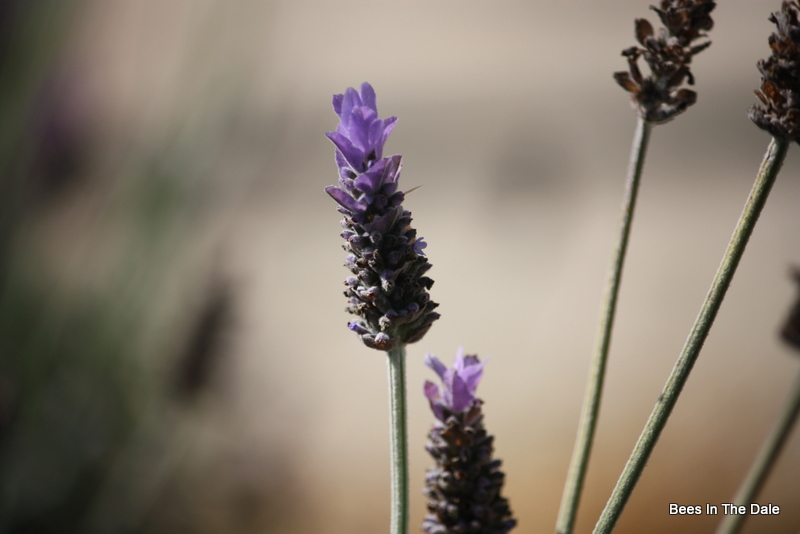
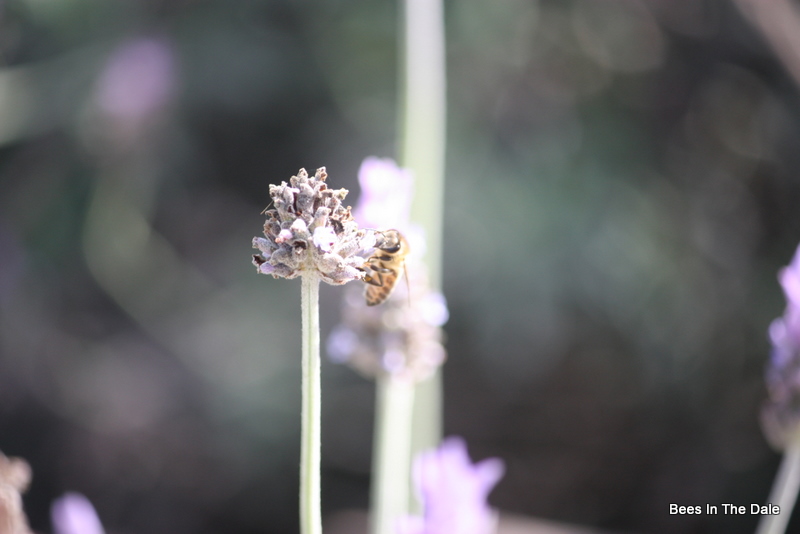
This is the main target for the bees right now.  I think they are my bees but I cannot tell.  This kind of lavender seems to have blooms all year long and I have plants very close to the hives.
Just like the Field of Dreams, plant it and they will come.
It must be very good nectar or maybe the only nectar close by.


Getting good sharp shot of bees is difficult.  What you see if the best of 90 pictures.
Danger Will Robinson, Danger!!  Who is this?  It looks like a small praying mantis is hanging around in the lavender.  Click on the picture to make it a little larger.   Do they like bees?


Betty keeps an eye on all things that fly but she no longer gets too close to bees.  One time with buzzers caught in her fur was enough. She is fearless, not stupid.  Cairn Terriers Rule.

 Spring is rapidly approaching in So Calif but the weather now has been cool, warm, hot, wet, you name and you get it.  That makes it hard on the bees at the moment but they are out working every chance they get. 


Thursday, February 3, 2011

All In The Family

Last May I was able to visit my niece's apiary in Oakland. CA.   She started beekeeping shortly before I did in 2009.  We did not know of each other's interest at first.  It has been helpful to have a family member who "understands."  I posted about my visit last year but shortly afterwards there was a problem with my blog and updating on blog rolls.  My posts were not showing up anywhere.  In the process of fixing the problem I deleted the blogs that did not update.  One of them deleted was this post and I wanted to get it back up.  It is not quite swarm season in So Cal so this is a good time to revisit the visit. 

Tricia's bees are located on a slope between the front of her house and the street.  There is plenty of vegetation to screen the bees and the hives are visible from the deck above.  In her area, May is when the bees are really starting to work.  Located close to the San Francisco Bay it can be cool well into the Spring. She wanted to see how the hives were doing.

 The top super did not have much activity but the other two were loaded with bees.


 In the two shots above you may find the queen.  When Tricia spotted it and pointed her out I tried to snap off a shot but usually she was gone by then.  See if you can find her, I didn't.
 Lots of bees and capped honey on all of the frames in the second super.  There was all sorts of things going on in the hive.

Queen Cell maybe a swarm or a new queen.
Opened Queen Cell
Click on this and look closely at the bee in the middle and you can see an egg in the cell just off her wing tip.
Nurse bees and larvae

This hive was very healthy and active with a prolific queen so Tricia closed it up

On to the small hive populated by a collected swarm.

These were very nice little girls, never complaining about how they were handled.  The beek was gentle.

This is a single super and still had some sugar water in the baggie

After a cursory check, Tricia decided to not bother them any more after adding another super..

The beek and her girls all back in place.
 It was a fun visit and nice to have time to take a lot  of pictures (90+) for the blog.  Her Mom & Dad are doubly happy, honey from two sources.. Northern and Southern California.  This year we will have to compare honey.
 

Thursday, January 13, 2011

The Bee Vac As Art


Basically a Bee Vac is a couple boxy pieces that fit over and under a super or nuc used to collect bees using a shop vac.  I have seen Steve Rosales use his a couple of times.  He made his according to plans and ideas from Robo's World BushKill Bee Blog.  I decided I could use one but wood working is not one of my skills.   Fortunately I was able to trade some cooking skills with my good friend Steve Shultz (the guy in the picture.) for a bee vac.  I had scanned over Robo's page and seen Steve Rosales' bee vac in action so I had an idea of what I wanted.  The only real change I suggested was side rails to keep the super from shifting when in transit.
Any time you make a simple suggestion to an engineer expect more than simplicity back.  
Steve is an engineer with imagination and loves a challenge.  He delivered, big time. He read through all the notes from other bee vac makers and incorporated some of their ideas and a few of his own.


The basic two piece unit with a slopped floor raising from the intake hole on the bottom piece.
Both pieces have dove-tail joints on the corners
Intake hole cover is held in place with magnets and easy to open or close, even with bee gloves on.

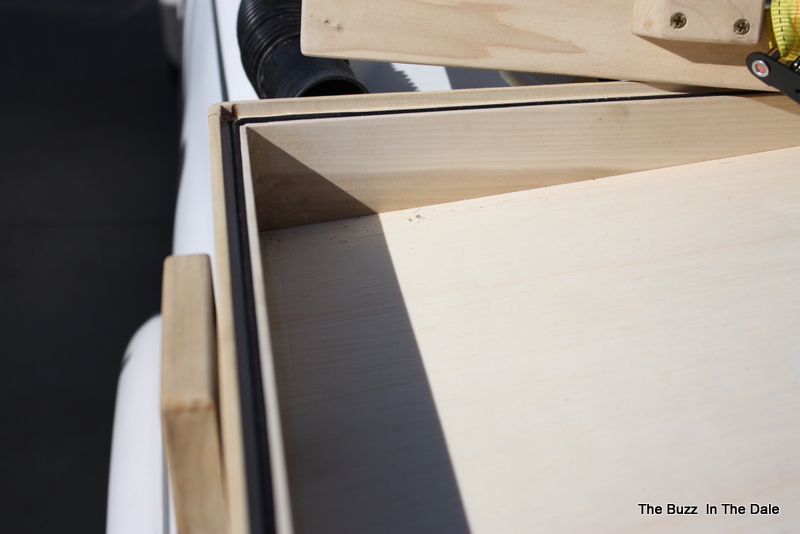
Rubber gaskets are around all sides on both pieces.  The super sits inside on top of the gaskets of the bottom and the same for the top piece.. A little extra space within the top and bottom allow supers that are not quite square to still sit on the lip tightly.

Custom made brackets for a ratchet strap that is tied other side of the top piece.  When tightened the top and bottom pieces will fit tightly and there will be no spaces for bees to leak out during transit.

Top piece with a screen bottom below the outflow hole for the vacuum.
Top piece cover, air flow controller.  There are magnets on the four corners to hold it in place and magnets in the top frame piece
Air flow controller in place and partially open

Underside of the bottom showing the slanted floor and rubber feet
Bee Vac with a spacer between the two pieces for storage without a super between them
 
Bee Vac closed and secure for moving.
The craftsman and the Bee Vac. The outside wood is all sealed, interior is raw wood with no sealer  or paints.
Thank you Steve for a job very well done and Robo who made the earlier version and also Steve Rosales for showing me how to use a Bee Vac.  All just in time for the Spring Flow, who could ask for more?

(The Bee Vac will show up at the meeting on Jan. 16.)