Saturday, March 12, 2011

Swarming A Hive


Danny with some of the booty from a large hive collected at Pierce College.  10 or so Backwards Beekeepers made the 6:30AM arrival to gather up these bees.  The bees had been touchy when approached earlier in the wee but were not bad today.  With a bit of smoke and sugar water they were relatively calm and only one sting was reported.  (I had to make a couple extra trips back to my truck for Bee Vac parts and neglected  to have my hat on and one girl spotted a target of opportunity.)
Tom putting brood into frames with Gwen capturing it for posterity.  Ruth gave a quick seminar on Housel positioning while this was being done.  I understand it better but not 100% yet.
There is a queen cell shown here.  One piece of comb had at least five queen cells as did others.  The hive was supplying bees for the area over a long period of time.
Using the Bee Vac to remove bees from the comb.  This was the inaugural test for the Mighty Bee  Vac and it worked very well after a couple small adjustments.  Almost everyone got a chance to man the hose.  There were plenty of bees for everyone.
The honey bucket is about to over flow.
This is near the end of the removal.  All the light covered area had comb on it.  Some pieces were two and half feet or longer.
Roberta checks the bees in the Bee Vac. 
The cutting board after all the comb has been cut down and put into frames or the comb buckets.
These are the bees as they arrived at Tom's for their new home.  The Bee Vac plastic lid was removed for the trip to make sure there was enough air and it was covered with a sheet for extra protection.  The design worked just fine and none of them got out.  But they were very annoyed when the sheet was first removed.  By the time they were ready for the hive they had calmed down a good bit.
There were special plans on how to remove the super from the Bee Vac.  Once on site Tom and I decided to use the direct approach.  He put a super full of brood on the bottom.  Then I lifted the BV super and Tom pulled out the bottom of the BV and this super was placed right on the brood super.  The same minimal approach was used for the top.   Remove the BV top and drop a top board on the hive.   Pull the plug off the bottom of the brood super and leave the area, quickly.
Tom and his bees should be happy in Highland Park.  One bee did follow us to the street but she left without out getting either of us.
All in all, a fine operation.  A large hive was rescued before the building it occupied was destroyed.  Had Backwards not stepped in the hive would have been sprayed.  Several club members left with brood for their hives, a couple of us had some honey and Tom has a new hive.
Best of all everyone got some valuable experience and the Mighty Bee Vac proved to be a full success.

I do have some videos from the event.  Once I figure out how to do it, I hope to have them up on youtube and linked to this site.  

Once again Backwards Beekeepers helps save the world, one hive at a time.

Tuesday, March 1, 2011

Sticky Bees in The Morning

 Late last night I got a call from Ed Garcia.  In December 2009 I had helped Steve Rosales collect a hive out of a tree.  Those bees found their way to Ed's house and late yesterday they had swarmed.  It was starting to get dark so we decided to wait until this morning to collect them.  It has been very cold for So Cal and the bees would not be moving early.
The bees were in a swarm cluster about seven feet up In a quince tree.  It was still slightly overcast at 9:30am, still on the cool side and the cluster did not have many active bees.
Below the cluster there were a lot of bees that had fallen off the cluster.  Some were moving and probably will come back to life when the sun warms them up.

The bees were almost out of reach but Ed clipped the branches and I collected the bees as best I could.
The bees were still not very active and some clumps fell to the ground but the bees would come to the queen in time.

The branches were dropped directly into  the nuc until they were all cut down, then I removed the vegetation for the nuc.  The nuc was deliberately placed near the bees on the ground in case they recovered.
A few small clusters remained in the tree for now but they would find the queen if she was in the nuc as I hoped.
The bees were not extremely active or aggressive but they did encourage Ed to move away.  I had some thin trousers on instead of my bee suit pants and had a couple bee reminders before we were done. That the price of playing with bees and maybe my sore knees will feel better now.
When bees are cold they are sticky, very sticky, clinging onto almost anything including the beek.
They loved my hat and remained in clumps where ever they landed but the hat seems a very special place to them. Could it be a fat head provides a bigger better landing area?.
Main work done, waiting for the bees to move in.
Some of the bees were climbing up the side of the nuc looking for the queen. Most of the bees were in the nuc which will remain in place the rest of the day.  Later in the evening Ed will put the lid on the nuc and move the bees next door.  He already has a a base ready for the nuc and can replace that with a super in a couple of weeks.
These girls will find the queen when they are a little warmer.
Even after getting Ed to brush me down before I left there still was one small cluster of sticky bees that was not quite ready to fly yet

This was a nice way to start the day and my first swarm capture of the year.  Ed will expand his apiary with bees he already knows.   They were not aggressive back on 2009 and still seem to be the same now.  I looked at his other hive.  It has an empty super on the top, Ed added it a few weeks ago but unknown to him the bees had already decided to swarm.  His added  box would not have any effect on the swarm plans.   In a few days Ed will take the empty super off the top of the hive and move it to the bottom.   Sometimes the bees will go down easier than go up and this may prevent another swarm.  
Ed gave me a video he shot of the hive capture back in 2009.  I will have to find a way to edit it down.  It was a fun job and I learned a lot but no one I knows needs to watch a video of the length it is now.  I already bore them with bee stories, a bee video might be too much.
I could have used the Mighty Bee Vac this time but  it is better suited for a cut-out.  The Bee Vac needs to go to work, Soon.

Sunday, February 27, 2011

Simple Solar Wax Melter

This is my version of a solar wax melter that I have seen on Linda's Bees and other sites.  It is the cheapest comb processor there is and it works. 
The first thing you need is a cheap styrofoam cooler
Paint the inside with dark paint, a flat black spray paint is best
Get a container that fits in the cooler box, add some water and then spread a paper towel across the top. Then secure it, a rubber band can work.   Put your wax on top of the towel..


Cover it with a pane of glass or plastic and set it in the sun.  The glass is to keep any nosy bees away and still let the sun heat things up.
The clean wax will flow through the towel and drop into the water.  What is left is the slumgum, all of that dark stuff left by the bees dirty feet.  This small bit of wax was in the sun for about two hours.  I left to to go do some other things so it might have been done much earlier.  Throw away the slum gum.

The wax will drop into the water so you can gather it without it sticking to the container.
This was not a lot of wax but it was from the partial frame of comb that had fallen out of the frame that I mentioned a couple posts back.  It is clean and I will save it for later use.
This is the wee pile of clean wax next to a tablespoon measure. Small but lovely and clean and nothing like the dark wad of wax I started with..
From Wikipedia: Slumgum is a term used in beekeeping. Slumgum is the residue of the beeswax rendering process. When the beeswax from brood comb is melted it contains not only wax but also the pupal lining, wax moth cocoons, excrements from larvae, and other residual debris. Less slumgum can be expected from rendering of cappings or honey comb. In the rendering process, the slumgum is separated from clean wax. Slumgum is slightly heavier than wax and sticks to the bottom of the wax cake. It is brown to black in color, and burns readily. Melted slumgum can be poured over pine cones to make fire starters

 There are bigger and better ways to deal with your wax but most of us Backwards Beekeepers are very small scale beeks collecting honey using crush and strain.  This method of rendering the wax  should work fine.   I do have an old solar oven that I will adapt to melt the wax but it is not high on my list atg the moment.   If you have a lot of wax you want to do at one time cheese cloth might work to replace the paper towel which cannot carry a big load of wax. .  I don't have enough wax to try that yet.  You need something that lets the liquid wax flow through and keep out the slumgum.

There are all sorts of things you can do with the wax other than making clean starter strips.  Check the main bee supply places like LA Honey,  Brushy Mountain and Mann Lake.   They have books and equipment to help you make candles, lip balm and all sorts of other useful things.

Sunday, February 13, 2011

An Early Peek in Feburary

The massive two hive apiary,
Home of the Twitchy Bees, the subject of this hive inspection

Before I start anything I put the lit smoker in front of the hive while I get everything ready.  The bees react to the smoke but the workers keep coming in.
The main reason for checking the hive is this one has always been very active and I want to add another super if it is needed.   The hive is four medium supers tall since I added one last June.    This is the only comb in #4 super, I moved it up in June and there has been no further expansion.  Looks like I do not need another super yet.  I may have to rename this hive to the Propolis Hive.  They produce an incredible amount of propolis and it is very hard to get the hive cover off.  Even though the bees are no using this super yet, the first frame was sealed in so tight that it came apart when I tried to take it out.  I put it back in and it should be fine when the comb glues it together.


These shots are of the honey in #3 super.
This one appears to have a swam cell but there is no brood here, must be burr comb.

#3 is full of honey. the two empty frames I swapped in during the Summer are still empty but the rest are full of comb and much honey.   Most of it must be from last year and what I left for the bees over the Winter.    Now if they will only move up and add some there.
The last frame has its own peculiar design issues.
This is super #2 and all of the frames seem to have comb connections between the frames.  It is a mess.  I tried to cut the the #1 & #2 frames apart but all I did was annoy the bees.  I could not remove one without the other so I moved on to other frames. 
I was able to remove frame #9 which had very little comb in it.  I had to get this one out, it was the last frame in the hive.  The starter strip had fallen down.   I put this in a bucket and replaced it  a clean frame.   I should have put this one back in but I forgot so I cut the comb off and laid the empty frame on the hive so the bees can clean it up and get the honey.
This is a deep as I went into the hive.  When I was in super #3 and #4 the bees were nice.  Things changed when I moved into #2 and removed the wayward comb.  Smoke helped but not much.  My Brushy Mountain suit worked perfectly.  The  consensus is that hive is thriving and the queen is probably fine.  Without help I was not going any deeper to search for her.  The bees have always been active and still are.  
I went out later for a cursory look at the other hive but the Twitchy guard bees told me to back off.
I elected to do that.  These bees are fine when I start but the attitude changes when I get into #1 & #2 supers. 
The Playa Vista hive is much calmer and I had glanced at the top super on it a week ago and it is not close to being full yet.  
I did set up my Flip camera as I was doing the inspection but I did not plan well.  90% of the time you are getting shots of my butt as I work on the hive.  %5 of the time I am getting the still camera and taking shots.  100% of the time the camera is aimed too high.  Good little camera but this was an operator error.  
We are getting more and longer warm spells now.  I expect to be in for another inspection in April.  See you then. 

Tuesday, February 8, 2011

Spring Is On The Way

No bees here but these little daffodils were planted 5-6 years ago and this is the first time they have bloomed.  They deserve the spotlight.
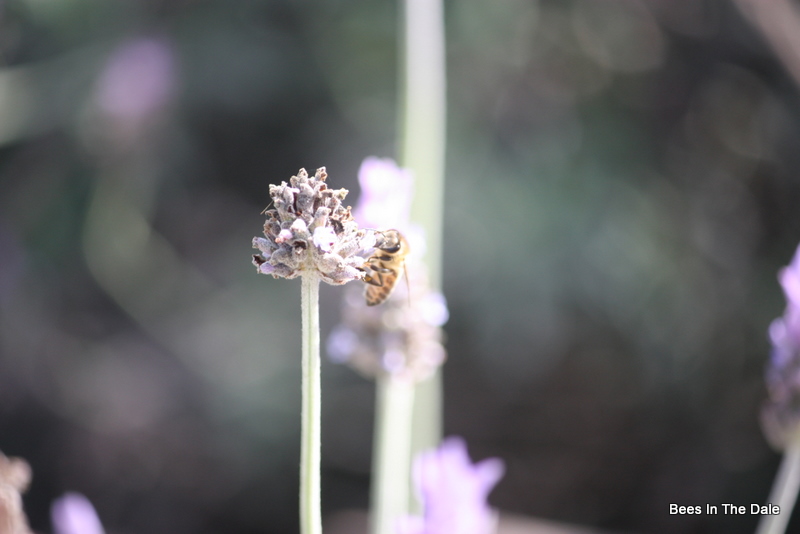
This is the main target for the bees right now.  I think they are my bees but I cannot tell.  This kind of lavender seems to have blooms all year long and I have plants very close to the hives.
Just like the Field of Dreams, plant it and they will come.
It must be very good nectar or maybe the only nectar close by.


Getting good sharp shot of bees is difficult.  What you see if the best of 90 pictures.
Danger Will Robinson, Danger!!  Who is this?  It looks like a small praying mantis is hanging around in the lavender.  Click on the picture to make it a little larger.   Do they like bees?


Betty keeps an eye on all things that fly but she no longer gets too close to bees.  One time with buzzers caught in her fur was enough. She is fearless, not stupid.  Cairn Terriers Rule.

 Spring is rapidly approaching in So Calif but the weather now has been cool, warm, hot, wet, you name and you get it.  That makes it hard on the bees at the moment but they are out working every chance they get.